Foundation crack repair for slab houses
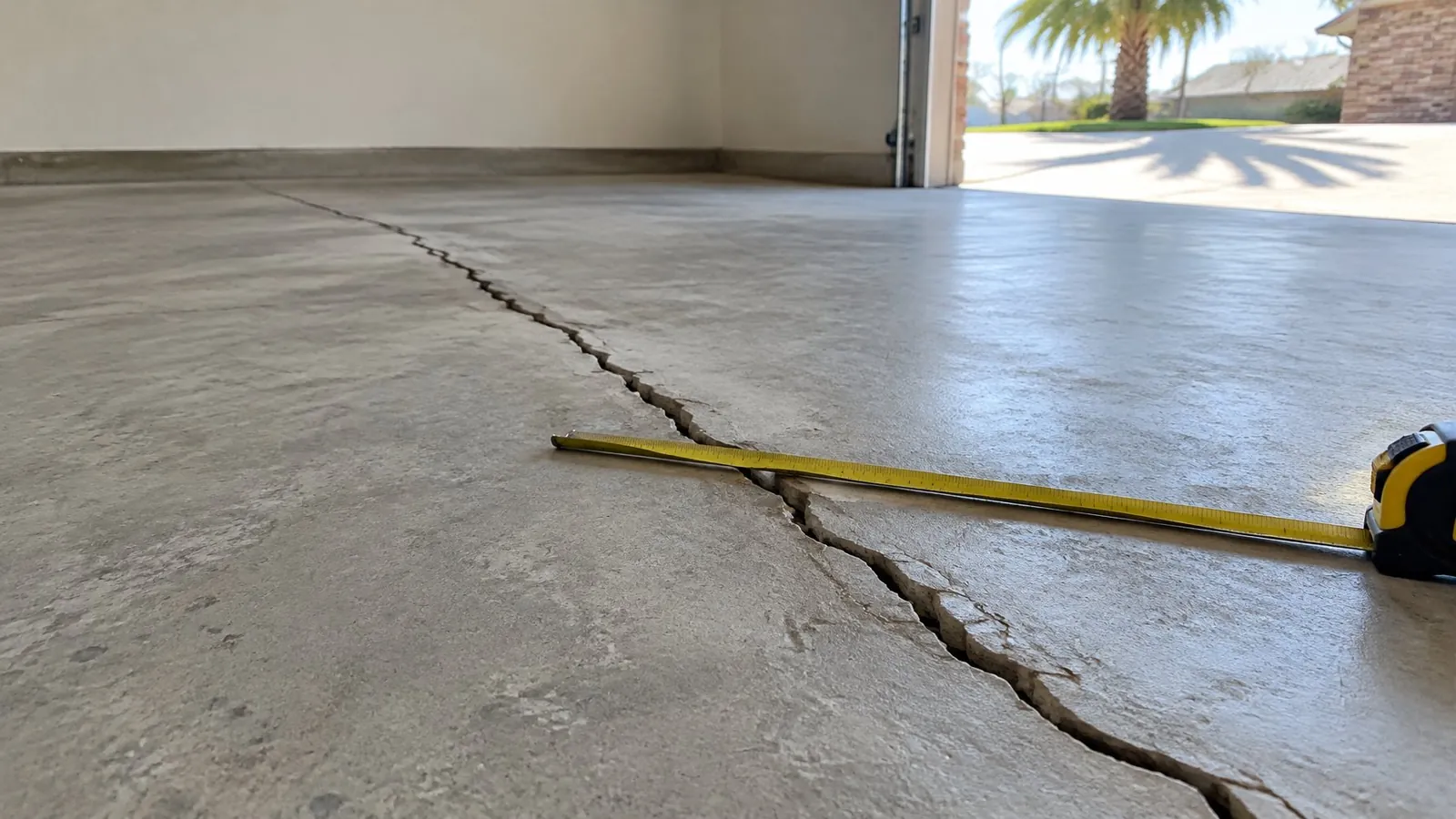
Five kinds of slab crack
The garage floor and the exposed slab edge outside are the two places you can see the concrete without lifting flooring.
- Hairline, flat
- Thread-thin, with no lip between the two faces. Curing concrete shrinks and leaves these behind during its first year. Almost every slab has some, and most stay as they are.
- One side higher
- If you can feel a step with your shoe or a coin catches on it, the slab has moved on one side of the crack. Estimators hunt for exactly this.
- Wide or widening
- Room for a pencil in the gap, or growth past your dated pencil tick, says the two halves are drifting apart.
- Through the edge
- A crack visible on the outside face of the slab, especially with a matching crack in the brick above, needs assessment of the slab edge and any related movement in the house.
- A line of cracked tile
- Tile is brittle and cracks when the concrete beneath it does. A straight run of broken tiles across a room often traces a slab crack you cannot see.
What a company checks
Expect the crack to be measured for width and for any step across it, and followed to see where it starts and stops. Height readings either side reveal whether the crack acts as a hinge, with the slab bending along it.
Because a wet patch of clay can push a slab up from below, they may also ask about your water bill and recommend a leak test on the drain lines under the house. Only a licensed plumber runs that test. Should it find a leak feeding the clay, pipes get mended ahead of concrete.
How cracks are repaired
Two different jobs go by the name foundation crack repair. One treats the crack: it is cleaned out and filled with epoxy, which glues the concrete, or with a flexible sealant that keeps water and insects out. This suits a crack that has stopped moving.
The other treats the movement. If the slab on one side of the crack is still dropping, filling the crack does nothing for long, so the bid will more likely list piers below the sunken half. A proposal should say which of the two it is and why. If it offers only injection for a crack with a step in it, ask what will stop the step growing.
Questions about slab cracks
Is a crack in my garage floor a foundation problem?
Often not. Garage floors crack more than the rest of the slab because they are large, plain and exposed to heat. A flat hairline crack is ordinary. Look for a step, for widening, and for cracks in the brick or walls nearby before you worry.
Can water come up through a slab crack?
Yes, damp can rise through a crack after heavy rain when the ground is saturated, and termites use cracks too. Sealing a stable crack is worthwhile for those reasons even when the structure is sound.
Will sealing the crack stop it getting worse?
Only if the slab has stopped moving. Sealant and epoxy do not hold a foundation up. They are a finish for a crack whose cause has been dealt with or has gone quiet.
A lip you can catch a coin on, or a gap wider than last season, deserves a professional look.
Call (361) 217-1905Ready for someone to measure the house?
Dial the number and say what you have noticed. A foundation repair firm covering your part of the Coastal Bend answers, books a visit, and afterward sends its report and price under its own name. That firm is a separate business from this website.
Wall, ceiling or floor shifting while you watch? Gas in the air? Get everybody outdoors, then phone 911 or the gas utility.
House foundations only
Call (361) 217-1905Corpus Christi Foundation Repairs refers callers and repairs nothing itself. Calls may be recorded. Details: referral disclosure.